
Read | 2 Corinthians 2
In fact, I made up my mind about this: I would not come to you on another painful visit. For if I cause you pain, then who will cheer me other than the one being hurt by me? I wrote this very thing so that when I came I wouldn’t have pain from those who ought to give me joy, because I am confident about all of you that my joy will also be yours. For I wrote to you with many tears out of an extremely troubled and anguished heart—not to cause you pain, but that you should know the abundant love I have for you.
If anyone has caused pain, he has caused pain not so much to me but to some degree—not to exaggerate—to all of you. This punishment by the majority is sufficient for that person. As a result, you should instead forgive and comfort him. Otherwise, he may be overwhelmed by excessive grief. Therefore I urge you to reaffirm your love to him. I wrote for this purpose: to test your character to see if you are obedient in everything. Anyone you forgive, I do too. For what I have forgiven—if I have forgiven anything—it is for your benefit in the presence of Christ, so that we may not be taken advantage of by Satan. For we are not ignorant of his schemes.
When I came to Troas to preach the gospel of Christ, even though the Lord opened a door for me, I had no rest in my spirit because I did not find my brother Titus. Instead, I said good-bye to them and left for Macedonia.
But thanks be to God, who always leads us in Christ’s triumphal procession and through us spreads the aroma of the knowledge of him in every place. For to God we are the fragrance of Christ among those who are being saved and among those who are perishing. To some we are an aroma of death leading to death, but to others, an aroma of life leading to life. Who is adequate for these things? For we do not market the word of God for profit like so many. On the contrary, we speak with sincerity in Christ, as from God and before God.
Click here to listen to the Scripture in ESV.
Paul describes believers as the pleasing aroma of Christ to God, which smells like life to those being saved and death to those perishing. How can we actively cultivate the “aroma of Christ” in our daily lives so that our presence reflects Jesus to everyone we meet?
Focus
View this work of art by Bruce Herman, titled Elegy for Bonhoeffer, which connects to Sunday’s sermon passage.
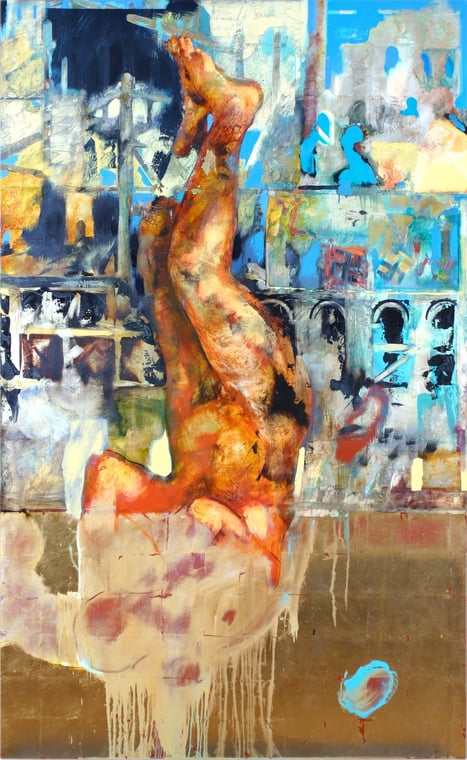
Observe what you see in the image, from colors to composition to recognizable elements, without trying to understand what it is supposed to mean. Then read about the work, using these details to help you interpret the work of art. Ask God what he might be saying through the image and listen for his insight in your thoughts and feelings; then take a moment to respond through prayer to what God showed you in this image.
Commentary:
Artist Bruce Herman is a distinguished American painter and educator who has worked at the intersection of art and faith for many years. The artist says of his work, “my deepest hunches as a painter center upon this truth: the body is the site of meeting — meeting ourselves, meeting others, meeting God. And meeting (entering-into) relationship is at the heart of my faith and my art.”
In the early 2000s, he created The Body Broken, a series of paintings he made after lightning struck near his home in Massachusetts, causing a devastating fire that destroyed his entire home and studio, and with it much of his life’s work. In these paintings, he explores lives of individuals called alter christus—other Christs—whose lives were laid down in martyrdom, and in particular he focused on the way these martyrs forgave those who persecuted them.
Dietrich Bonhoeffer was a German theologian and pastor who resisted Nazi rule and terror and was hanged for his resistance efforts. Bonhoeffer truly lived out his faith regardless of the cost and in his very body he bore the truth of the text, “Since then, we have such great hope, we act with boldness” (2 Corinthians 3:12).
In Herman’s painting, Bonhoeffer’s body is inverted and seems to be falling past a chaotic mix of Nazi symbolism and architecture—the ruins of human culture—and toward the solid, golden ground of God’s presence, even if what lies behind the gold is obscured from our gaze. Such a transformation is a mysterious affair, and Herman’s painting is a powerful visual reminder that sometimes the journey to being transformed in glory is not an ascent, but a descent, like that of our Lord Jesus Christ.
Art Source: Elegy for Bonhoeffer from The Body Broken, Bruce Herman, 2002. Used by permission. bruceherman.com
Pray
As you reflect on the beauty and message of this week’s piece of art, how is your heart moved to prayerful worship? Pray this short breath prayer prompt as you view this week’s piece of art:
Jesus, move my heart to joyfully obey.
Going Deeper
If you are also following the BibleProject’s One Story That Leads to Jesus reading plan, complete today’s reading.