Read | Genesis 3:1–24
Now the serpent was the most cunning of all the wild animals that the LORD God had made. He said to the woman, “Did God really say, ‘You can’t eat from any tree in the garden’?”
The woman said to the serpent, “We may eat the fruit from the trees in the garden. But about the fruit of the tree in the middle of the garden, God said, ‘You must not eat it or touch it, or you will die.’”
“No! You will certainly not die,” the serpent said to the woman. “In fact, God knows that when you eat it your eyes will be opened and you will be like God, knowing good and evil.” The woman saw that the tree was good for food and delightful to look at, and that it was desirable for obtaining wisdom. So she took some of its fruit and ate it; she also gave some to her husband, who was with her, and he ate it. Then the eyes of both of them were opened, and they knew they were naked; so they sewed fig leaves together and made coverings for themselves.
Then the man and his wife heard the sound of the LORD God walking in the garden at the time of the evening breeze, and they hid from the LORD God among the trees of the garden. So the LORD God called out to the man and said to him, “Where are you?”
And he said, “I heard you in the garden, and I was afraid because I was naked, so I hid.”
Then he asked, “Who told you that you were naked? Did you eat from the tree that I commanded you not to eat from?”
The man replied, “The woman you gave to be with me—she gave me some fruit from the tree, and I ate.”
So the LORD God asked the woman, “What have you done?”
And the woman said, “The serpent deceived me, and I ate.”
So the LORD God said to the serpent:
Because you have done this,
you are cursed more than any livestock
and more than any wild animal.
You will move on your belly
and eat dust all the days of your life.
I will put hostility between you and the woman,
and between your offspring and her offspring.
He will strike your head,
and you will strike his heel.
He said to the woman:
I will intensify your labor pains;
you will bear children with painful effort.
Your desire will be for your husband,
yet he will rule over you.
And he said to the man, “Because you listened to your wife and ate from the tree about which I commanded you, ‘Do not eat from it’:
The ground is cursed because of you.
You will eat from it by means of painful labor
all the days of your life.
It will produce thorns and thistles for you,
and you will eat the plants of the field.
You will eat bread by the sweat of your brow
until you return to the ground,
since you were taken from it.
For you are dust,
and you will return to dust.”
The man named his wife Eve because she was the mother of all the living. The LORD God made clothing from skins for the man and his wife, and he clothed them.
The LORD God said, “Since the man has become like one of us, knowing good and evil, he must not reach out, take from the tree of life, eat, and live forever.” So the LORD God sent him away from the garden of Eden to work the ground from which he was taken. He drove the man out and stationed the cherubim and the flaming, whirling sword east of the garden of Eden to guard the way to the tree of life.
Click here to listen to the Scripture in ESV.
Each week, we’re reminded that experiencing God happens best through Scripture alongside others—join us for worship today at one of our five campuses and grow together in faith. Read today’s Scripture in preparation for today’s sermon titled "Fall."
Focus
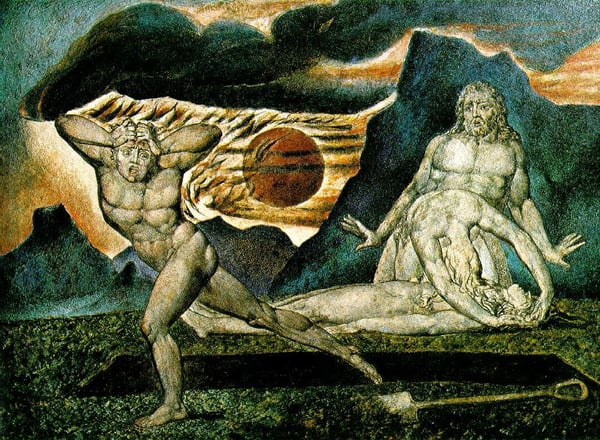
View this work of art titled The Body of Abel Found by Adam and Eve by William Blake, connected to Sunday’s sermon passage.
Visio Divina, or ‘divine seeing,’ is a way of praying and reflecting through art. As you look at this week’s piece, take a few quiet moments to notice details, colors, or emotions that stand out to you. Ask God what he might be saying through the image, and listen for his insight in your thoughts, feelings, or prayers.
Commentary:
Many know William Blake as a poet more than an artist, but he was an innovator and master of both literary and visual arts, and everything he did was deeply steeped in and informed by the Bible. In his poem, The Everlasting Gospel, Blake touches on the challenge of Scripture being interpreted in myriad ways—"Both read the Bible day and night / But thou readst black where I read white.” Despite his acknowledgement that engaging with the Bible can be a difficult endeavor, it’s clear that Blake found it worthwhile.
He made numerous biblical illustrations throughout his career, but few are quite as emotionally charged as this one. Cain, either consumed with horror at his deed or being caught by his parents, flees the scene in madness and fury. The setting sun seems to follow in his wake, perhaps a sign of the cyclical, ever-present nature of his sin, which will follow him all the days of his life as surely as the sun will rise and set.
Eve’s posture conveys despair and anguish, and Adam watches his son flee with arms flung out in shocked surprise. Art historian Tom Gurney suggests that Adam’s outstretched arms indicate “he is trying to hold back the towering mountain from caving in on them.”
Art Source: The Body of Abel Found by Adam and Eve, William Blake ca. 1826, Tate Gallery, London. Public domain, via Wikimedia Commons.
Pray
Lord Jesus,
Today is your day—the gift of rest, the open door to worship, the living reminder of your resurrection, and a glimpse of the eternal Sabbath to come. On this day, may all your people—struggling and triumphant—join in endless praise.
Fill my mind with peace that surpasses understanding. Let my thoughts be sweet, my worship alive, my heart free and joyful. May I drink deeply from the streams that flow from your throne, feed on your precious Word, and stand strong behind the shield of faith. Draw my heart ever closer to you, Jesus, today and always.
— Adapted from The Valley of Vision, edited by Arthur Bennett
Going Deeper
If you are also following the BibleProject’s One Story That Leads to Jesus reading plan, complete today’s reading.
Conversation Starters
The Bible is best studied with others. Talk about today’s sermon with someone else (friends, family, neighbors, at lunch, or in your community group). Use the questions below to get you started!
Genesis 3 shows a shift from life with God to life apart from him. Where do you see that tension playing out in the world around you—or in your own story?
The serpent’s strategy was deception. What kind of lies do you think people are most tempted to believe today about God or themselves? What are some lies that you are tempted to believe?
Genesis introduces shame and hiding. How do you think those dynamics affect relationships today—with God and with others? What should we do when we experience shame?