
Read | Numbers 27
The daughters of Zelophehad approached; Zelophehad was the son of Hepher, son of Gilead, son of Machir, son of Manasseh from the clans of Manasseh, the son of Joseph. These were the names of his daughters: Mahlah, Noah, Hoglah, Milcah, and Tirzah. They stood before Moses, the priest Eleazar, the leaders, and the entire community at the entrance to the tent of meeting and said, “Our father died in the wilderness, but he was not among Korah’s followers, who gathered together against the LORD. Instead, he died because of his own sin, and he had no sons. Why should the name of our father be taken away from his clan? Since he had no son, give us property among our father’s brothers.”
Moses brought their case before the LORD, and the LORD answered him, “What Zelophehad’s daughters say is correct. You are to give them hereditary property among their father’s brothers and transfer their father’s inheritance to them. Tell the Israelites: When a man dies without having a son, transfer his inheritance to his daughter. If he has no daughter, give his inheritance to his brothers. If he has no brothers, give his inheritance to his father’s brothers. If his father has no brothers, give his inheritance to the nearest relative of his clan, and he will take possession of it. This is to be a statutory ordinance for the Israelites as the LORD commanded Moses.”
Then the LORD said to Moses, “Go up this mountain of the Abarim range and see the land that I have given the Israelites. After you have seen it, you will also be gathered to your people, as Aaron your brother was. When the community quarreled in the Wilderness of Zin, both of you rebelled against my command to demonstrate my holiness in their sight at the waters.” Those were the Waters of Meribah-kadesh in the Wilderness of Zin.
So Moses appealed to the LORD, “May the LORD, the God who gives breath to all, appoint a man over the community who will go out before them and come back in before them, and who will bring them out and bring them in, so that the LORD’s community won’t be like sheep without a shepherd.”
The LORD replied to Moses, “Take Joshua son of Nun, a man who has the Spirit in him, and lay your hands on him. Have him stand before the priest Eleazar and the whole community, and commission him in their sight. Confer some of your authority on him so that the entire Israelite community will obey him. He will stand before the priest Eleazar who will consult the LORD for him with the decision of the Urim. He and all the Israelites with him, even the entire community, will go out and come back in at his command.”
Moses did as the LORD commanded him. He took Joshua, had him stand before the priest Eleazar and the entire community, laid his hands on him, and commissioned him, as the LORD had spoken through Moses.
Click here to listen to the Scripture in ESV.
Moses’s final public petition is not for his own life or status, but that God would appoint a new leader so the people would “not be like sheep without a shepherd” (Numbers 27:17). What does Moses’s final, selfless concern for the welfare and cohesion of the people teach you about true, God-honoring leadership? How can you practically pray for the leaders in your life, (pastors, civic leaders, managers) that they would possess this “shepherd's heart”?
Focus
When the term behold is used in Scripture it means to fix the eyes upon, to see with attention, to observe with care, as when John the Baptist saw Jesus, he said “Behold.”
View or behold this work of art, titled Hear, O Israel: Love! / i. Lev (to love with the intellect and emotion), ii. Nephesh (to love with the singular longing of the human person), iii. Me’od (to love with all capacities and resources), by Kelly Kruse, connected to Sunday’s sermon passage.
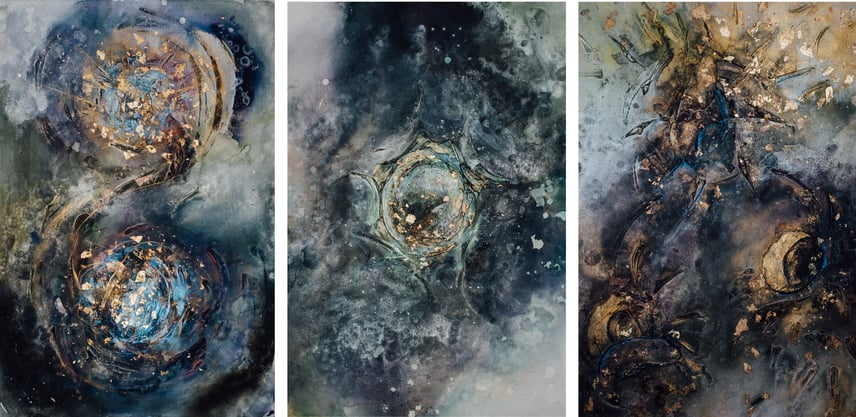
Visio Divina, or “divine seeing”, is a way of praying and reflecting through art. As you look at this week’s piece, take a few quiet moments to go through a three-step process. First, observe what you see in the image, from colors to composition to recognizable elements, without trying to understand what it is supposed to mean. Then read about the work, using these details to help you interpret the work of art. Ask God what he might be saying through the image, and listen for his insight in your thoughts, feelings, or prayers. Finally, take a moment to respond, through prayer or journaling, to what God showed you in this image.
Commentary:
The Shema (Deuteronomy 6:4–9) establishes there is only one God, and then it gives a command to love him with the whole self, using the three words lev (heart), nephesh (soul), and me’od (strength) to describe the human person. Artist Kelly Kruse has illuminated each word in this triptych inspired by the Shema, a work which she created for exhibition at Four Chapter Gallery located at the Downtown Campus in 2019 in response to an invitation to make work that imagined human flourishing:
Ahavah is the type of love that is commanded in this passage. The word ahavah doesn’t just refer to a feeling, it also refers to an action—something done or given. We all understand when someone tells us they love us, it means nothing without action. In Deuteronomy, the Shema is called the greatest commandment, and it is linked through the arc of Scripture to Jesus's new commandment in John 13:33–35.
Yet Leviticus 19:18 commands “love your neighbor as yourself,” and in 19:34, “love the stranger as yourself.” So, Jesus wasn’t commanding something new when he was asking his disciples to love others. Therefore, he must have been talking about the form or quality of the love, not the person being loved. Nowhere in Scripture do we see someone display ahavah with the radical grace of the God-man, Jesus, who loved his brothers and sisters so much that he died a humiliating, bloody death, alone on the cross as a sacrifice for their sins. This is a love he gave with all of himself: his capacities and resources, his deepest desires, his pain, his beauty, and his very life. He invites each of us to do the same through him.
Art Source: Hear, O Israel: Love! / i. Lev (to love with the intellect and emotion), ii. Nephesh (to love with the singular longing of the human person), iii. Me’od (to love with all capacities and resources), Kelly Kruse, 2019, Used by permission. kellykrusecreative.com
Pray
O Lord, you see that all hearts are empty unless filled by you, and all desires are frustrated unless they point to you. So give us light and grace to seek and find you, that we may be yours, and you may be ours, forever.
-Christina G. Rossetti, from Prayers Ancient and Modern
Going Deeper
If you are also following the BibleProject’s One Story That Leads to Jesus reading plan, complete today’s reading.